Showing posts with label Tom Dendy. Show all posts

Wednesday, December 16, 2009

The Connected Adolescent

Wow, has it really been that long since I've shared my thoughts online?! Maybe it's been the 300,000 miles on airplanes this year or the continuous mad scramble to keep business flowing in this unprecedented economy.There certainly hasn't been any lack of conversational topics, though...

It's almost a cliche' anymore to point out the ways that the internet and information age has changed our life and how we interact. Early last year, I referenced Sean Tevis' indoctrination into political activism. I still remember the day he walked into my office relaying to me how he had been encouraged to launch a campaign for Kansas State Representative, Michelle had suggested that he solicit my view on the matter. With no funds and no political background running against the incumbent retired police chief in a strongly conservative Republican district, it seemed a bit of senseless folly, and with their first child on the way....perhaps Michelle expected me to talk him out of the idea (I never went back and asked her, she intimidates me too much). Not knowing at the time that I would be moving to Oregon in less than 2 months, I told him he would be a fool not to run, and that, as the underdog, he should turn this into a new media campaign ("go with what you know" I told my favorite web developer and blogger). Remember what happened earlier this year in Malaysia, right? (actually, most people in Kansas had not paid much attention to the political revolution in Malaysia earlier that year, so the reference was somewhat lost). Well, the rest, as they say, is history. Gaining national media attention for his web-based fund raising efforts, Sean made this laugher of a race incredibly close. It was Balboa-Creed I. It was so frightening for the establishment, that they introduced the "Sean Tevis Bill" right after the election, attempting to make sure that these new media activists can't threaten to upset the balance of power ever again (good luck with that one, I guess)....

Closer to home, though, I have entered that magical phase of fatherhood known as adolescence and puberty. Probably high on the conscious mind of any parent (and child) at this stage is social development. I have noted a trend in my own social interactions over the last 5 years. With the explosion of social media and constant connectivity, I find myself continuously connected with hundreds of friends and colleagues, even from the far corners of the earth. If I need professional advice on a marketing campaign, I can instantly ping 385 of my friends and coworkers on LinkedIn, if they each forward it to a friend of a friend, it reaches a network of over 4,177,000 people! On Facebook, I'll post albums from our hockey teams, instantly notifying 225 friends and family of Tyler's game-winning goal.

So, the dilemma; at what point should a 12-year old kid be allowed to socialize online? Being the progressive parent, I decided to set up a profile for him. As it turns out, facebook requires users to be 18years old to have an account. Poking around, though, a noticed several of Tyler's classmates' profiles. After a conversation with my wife and establishment of a very strict set of house rules and requirements, we turned our 12 y/o loose on facebook. Guess I'm not the only parent choosing to overlook the minimum age requirements - less than 3 weeks later, he has a network of over 100 online friends and classmates. It struck me that, unlike those in my generation, my sons will likely not find themselves with "long lost friends". Remember when your best friend moved away after 3rd grade? Sure, you traded post cards time and again, maybe a phone call when his family passed through town (oh, the days of interstate toll calls...). But, by high school he was little more than a memory and the occasional "I wonder what ever happened to Bill Coffer?"

What about that random encounter? The "visiting from out of town - friend of a friend" you met at the Halloween party? Unless you made considerable effort, developing and maintaining a long distance friendship was a rare occurrence. Not today. Meet someone who you'll only see twice a year? Not a problem, link up on facebook, follow each other's twitter feeds and become life-long friends...

But I wonder - do we spend so much time online connecting remotely with the masses, that we will develop less deep relationships to the few closest to us? Hard to tell, really, as I sit in my easy chair receiving Farmville gifts from my wife, who is lounging on the sofa next to me, also working on her laptop. "Hey Ty," I yell to my 12 year old in the next room, "I need more chickens for my coop." "No problem, dad, I'll send you one." Such is life on the family farm....

Thursday, March 12, 2009

I'm not a salesman....really!


A double knit leisure suit, blue suede shoes, slicked back hair, the confident swagger, the artificial smile and the fast talking. Yep, we've seen the stereotype - the typical salesman. "He could sell refrigerators to Eskimos," is that frequently used cliche' to describe a "natural" salesman.

No wonder most people hate salesmen. Would you feel good convincing someone to spend money on a product that they don't need? I think these people are called "con artist".

So, when I decided to leave the Navy after 11+ years of highly technical, engineering and leadership experience, the last thing I wanted to do was degrade myself to the level of becoming a salesman. Somewhere along the way, though, I came under the influence of John "the Don" Devito, a laboratory chemist-turned-salesmen in the twilight of a glowing 35-year career at General Electric. Early on, John enlightened me with a very important lesson that I have been repeating and passing on for almost 11 years. With a scowling fixed glare, and a wag of the finger, John would repeatedly tell us "You are not here to sell products. You are here to solve problems!"

These words resonated particularly well with me. Some years earlier, as a newly assigned Engineer Officer on a Nuclear Submarine, my commanding officer (and mentor) would instruct me that, as a senior officer, my primary responsibility on board was to "Identify and correct deficiencies." So, it seemed, transitioning from Chief Engineer of a Nuclear Submarine to technical Sales Representative would be a relatively simple transition. Making things even more exciting for me, GE had just instituted its Six Sigma "At the customer, for the customer" initiative. This meant that all sales personnel completed Six Sigma Black Belt training and were required to participate in at least one customer Six Sigma process improvement project.

For those not familiar with Six Sigma, it is a process improvement methodology that utilizes a collection of statistical analysis tools to analyze and control the effectiveness and variance of a process. Not knowing any better, I latched onto this concept and became heavily immersed in a number of process efficiency projects with production engineers at my customers' facilities. This wasn't "sales", this was engineering and problem-solving.

Some years later, I found myself in a position to evaluate and recommend purchasing decisions for various business software packages. This meant that I was frequently on the other side of "sales" conversations. This is where I learned to actually dislike salesmen. Expecting the sales process to follow the pattern that I was taught at GE, I would come to meetings prepared to discuss the specific problems we were trying to solve and the detailed criteria we would use in our evaluation. I was repeatedly surprised when the software sales teams would come in and immediately jump into a sales presentation and demonstration of their software - taking no time whatsoever to determine my specific needs so that they could determine whether their technology was a reasonable solution. After a while, I just started avoiding these sales pitches altogether. Ironically, I spent the following year working as a software sales executive - and I don't think I did a single "canned" sales pitch the entire time.

Moving closer to my roots, the last several years have brought me back to that familiar ground of applying technology and engineering to improve the efficiency and profitability of customers' operations. At my current company, the "sales" people are the ones who design systems, size and select mechanical equipment and even do some of their own engineering. Oddly enough, one of our biggest customers recently reiterated that he did not want to have "salesmen" call on him - he wanted only "engineers" in his facilities that could solve his problems. As always, John the Don was right - we're not here to "sell" products after all.

Like I said - I'm not a salesman.....really

Saturday, November 15, 2008

Life as a Reformed Hockey Fan


At the half-way point of a 2-week business trip, I found myself with the prospect of a night alone in Chicago, with no business or social commitments. With a little help from friends, I happened upon a ticket to the Chicago Blackhawks hockey game. Not just any ticket, mind you, but a premium seat in the front row up against the glass.

I can count on one hand the number of NHL games I have attended in the past, and none in the last eight years. In that time span, I have learned a lot about the game - having coached well over a hundred youth games, attended multiple coaching clinics, read several books on coaching youth hockey, and spent several hundred hours on the ice. I guess it's natural to expect that I would have a different appreciation of the game, given the opportunity to watch it at its highest level.

I was super-excited about the game, this was my first opportunity to watch NHL players from the front row, in live action. The Hawks were playing the St. Louis Blues, which split my allegiances slightly. Last year, I was an assistance coach with ex-Blues player Tom Tilley, and the Blues were the closest NHL team to Kansas City. On the other hand, I had lived in Chicago several years ago, so the Blackhawks were my last true "home team". With no emotional ties to bias me, I could truly enjoy the game.

It didn't take more than about 15 seconds of live action to realize that I no longer watch hockey like I used to. Chicago won the face off and moved the puck into their offensive zone, after a wide shot, the Blues' left defenseman picked up the puck in the far corner and made an incredible pass to the right winger who had broken open near center ice, creating a 1 on 1 scoring opportunity against the lone defensemen who had dropped back. Despite this great scoring chance for the opposition, the home crowd was roaring in approval and excitement. It took me a couple of seconds to understand their obvious loss of synchronicity with the action on the ice - it was almost like they were watching a different game than me. This group of rabid fans were delighted by the powerful body check delivered by the Hawk's right winger on the defenseman who had just made the spectacular break-out pass. The fact that the visiting team was on the verge of a score did absolutely nothing to deflate the home crowd. Nope, I wasn't watching a different game, I was just watching the game differently.


I felt even more out of place a few minutes later when the first of 3 first-period fights broke out right in front of me. Now, anyone who knows me understands that I am not a tender-hearted pacifist by any means. Heck, I love watching one UFC fighter beat the living pulp out of his adversary just as much as the next guy. But watching two elite athletes, who master such a technically challenging game, reduce themselves to thugs on ice was, frankly, offensive. Of course, I was vastly outnumbered in my assessment of the incident. I think I captured the general atmosphere in one of my photos of the third fight of the period. [The gentleman sitting next to me, by the way, was equally as unimpressed with the stoppage of play. We were probably the only front-row ticket holders NOT on our feet, banging on the glass encouraging these athletes to beat the crap out of each other].


Luckily, it was a close game. As they always seem to do, the players set aside their UFC aspirations and focused on the business at hand for the final two periods (and the overtime period, up until the Blues' winning goal on an overtime power play.) My favorite games are the close ones - the speed and intensity stay elevated until the final horn - no THAT's hockey!

Thursday, August 14, 2008

We're not in Kansas anymore....

It was only after leaving Kansas and selling my home that I became aware of just how oppressive a place it is. States like Oregon (my new home), do so much more for me.

For example - did you know that:
(1) The dispensing of Class 1 flammable liquids by dispensers properly trained in appropriate safety procedures reduces fire hazards directly associated with the dispensing of Class 1 flammable liquids;
(2) Appropriate safety standards often are unenforceable ...in other states because cashiers are often unable to maintain a clear view of and give undivided attention to the dispensing of Class 1 flammable liquids by customers;
(3) Higher liability insurance rates charged... reflect the dangers posed to customers when they leave their vehicles to dispense Class 1 flammable liquids, such as the increased risk of crime and the increased risk of personal injury resulting from slipping on slick surfaces;
(4) The dangers of crime and slick surfaces described in subsection (3) of this section are enhanced because Oregon’s weather is uniquely adverse, causing wet pavement and reduced visibility;
(5) The dangers described in subsection (3) of this section are heightened when the customer is a senior citizen or has a disability, especially if the customer uses a mobility aid, such as a wheelchair, walker, cane or crutches;
(6) Attempts by other states to require the providing of aid to senior citizens and persons with disabilities in the self-service dispensing of Class 1 flammable liquids at retail have failed, and therefore, senior citizens and persons with disabilities must pay the higher costs...
(7) Exposure to toxic fumes represents a health hazard to customers dispensing Class 1 flammable liquids;
(8) The hazard described in subsection (7) of this section is heightened when the customer is pregnant;
(9) The exposure to Class 1 flammable liquids through dispensing should, in general, be limited to as few individuals as possible, such as ...owners and their employees or other trained and certified dispensers;
(10) The typical practice of charging significantly higher prices ....in [48 of the other 50 states] states:
(a) Discriminates against customers with lower incomes, who are under greater economic pressure to subject themselves to the inconvenience and hazards...;
(b) Discriminates against customers who are elderly or have disabilities who are unable to serve themselves and so must pay the significantly higher prices; and
(c) Increases self... dispensing and thereby decreases maintenance checks by attendants, which results in neglect of maintenance, endangering both the customer and other motorists and resulting in unnecessary and costly repairs;
(11) The increased use...in other states has contributed to diminishing the availability of automotive repair facilities...;
(12) Self-service dispensing at retail in other states does not provide a sustained reduction in fuel prices charged to customers;
(13) A general prohibition of ... dispensing of Class 1 flammable liquids by the general public promotes public welfare by providing increased safety and convenience without causing economic harm to the public in general;
(14) Self-service dispensing at retail contributes to unemployment, particularly among young people;
(15) Self-service dispensing at retail presents a health hazard and unreasonable discomfort to persons with disabilities, elderly persons, small children and those susceptible to respiratory diseases;
(16) The federal Americans with Disabilities Act, Public Law 101-336, requires that equal access be provided to persons with disabilities at retail gasoline stations; and
(17) Small children left unattended when customers leave to make payment at retail self-service stations creates a dangerous situation. [1991 c.863 §49a; 1999 c.59 §160; 2007 c.70 §276]

Yep, you guessed it, only New Jersey and Oregon have figured out how to protect their citizens in a way that is so flagrantly overlooked by the other 48 states - stop letting them pump their own gas. I would add an additional item (items 1-17 above are quoted from Oregon State Code 480.315)

(18) Consumers who self-serve run the risk of spilling gasoline on their shoes, which could lead to very embarrassing consequences, possibly even forcing them to conduct a formal presentation at a global leadership conference wearing only socks on their feet. [I believe this really could happen - just ask Sean.]

Speaking of Sean - he's gone political on us - even showed up in the national media, thanks to a very clever fund raising strategy.

Driving across country with the family this weekend - leaving behind those repressive days of having to fill my own gas tank....

Monday, July 7, 2008

Another fun book - for serial Entreprenuers


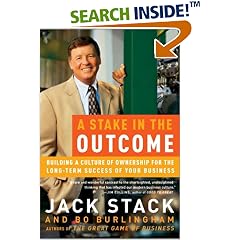
Last month, I wrote briefly about the full day seminar I attended that was hosted by Dr. Don Kuratko. Among other things, Dr. K gave me a whole slew of new books to read (leave it to the college professor to send me home with reading assignments). The first "must read" on his list was "A Stake in the Outcome" by Jack Stack. Being from Kansas City, I immediately assumed that I would be reading about the establishment of a BBQ empire - but apparently, this Jack Stack has not relationship to my favorite smokehouse.
The Jack Stack that wrote this book was a general manager of a engine rebuilding plant in Springfield, Missouri during a major corporate shake-up. Going out on a limb, and with no real idea of what he was doing, he found a bank that would loan him the money for a management buy-out of the plant, establishing the highly successful company SRC Holdings. Having been involved in a couple of small company start-up ventures myself, I can relate to the "figure it out as you go" attitude that Jack and gang adopted in those early days. Unlike my own experiences, though, Jack started out with an existing company with a long history and an established customer base, although over 50% of their revenue came from a single client (something that nearly killed them at one point).
The cornerstone of Jack's success was the creative way in which he got every employee of the company tuned in to what it takes to make the company successful. Contrary to the typical big business approach, where separate groups within the company only focus on their own goals, objectives and measures; Jack determined that, in a small company, everyone had an obligation to understand the ENTIRE profit & loss statement, balance sheet and cash flow. To do this, he invented the "Great Game of Business", a tool that has been adopted by thousands of companies worldwide. The stories in this book are incredible. There is so much living proof out there of the power of enlightenment and engagement, yet so many companies absolutely refuse to disclose their books to more than a handful of internal employees.
This book was a really motivating read! While I don't see myself leading a management buy-out anytime soon, it sure would be fun to find a way to play the great game of business.

Friday, June 20, 2008

The Strategic Tactician


It seems like we end up having this conversation pretty frequently - like every time we debate the potential fit of a new candidate, or when we are assigning positions on the crew of a sailboat racing team. Who is the strategist and who is the tactician?...my question becomes - "Can you truly succeed in one of these roles without being equally successful in another?"
While we all come across individuals who have either by nature, or by design limited themselves to operating in either a "strategic" or "tactical "realm, I have observed that truly successful leaders have usually demonstrated expertise in both areas - I'm really not sure how you can do it any other way.
Going back to my military days - every operating plan was devised based on an overall strategic mission. The top planners, intimately familiar with this mission, would select and assemble the appropriate bundle of tactical moves that, pieced together, would accomplish the strategy. As an officer of the line, it was our job to execute those tactical components to perfection. But as the saying goes - No plan can withstand the test of actual battle. As the execution unfolded, the front line leaders were invariably faced with unexpected circumstances not anticipated by the plan developers. In order to make the right tactical decisions to adjust on the spot, we needed to be intimately familiar with the overall strategy, therefore enabling us to make decisions that not only accomplished our tactical objectives, but also progressed us towards the strategic objectives. Leaders can never de-couple the two.
Conversely, the only way to become a true strategic leader is to have battle-tested knowledge and experience of the tactical environment. Strategic planning has little chance of success if the leaders do not fully understand the capabilities, limitations and dynamics of the "tactical" part of the organization.
Admittedly, there are plenty of people out there who gravitate towards one or the other. I prefer a good mix of both - what's your preference?

Tuesday, June 10, 2008

The "Helmet with Shoes" - Dr. K


After weeks of anticipation, and enduring 421 pages of dehydrating college text, the day finally arrived - a full day workshop with award-winning entrepreneur and famed academic Dr. Don Kuratko. Prior to the workshop, I had a chance to meet Dr. K and felt obliged to comment on his book - ok maybe not "obliged", but I certainly felt I had earned the right to issue a commentary. After explaining how delightfully painful it was to try to devour an entire college textbook over the course of a few airplane trips, he mentioned that others had suggested a non-textbook version of the material, which he felt would be difficult to do in a reasonable level of detail and/or value. I would say that Dr. K is suffering from the dreaded Curse of Knowledge, so I naturally recommended the Heath brothers' book "Made to Stick", which I had finally finished on the airplane the night before (I offered him my copy, but he was already planning to finish "Skin in the Game" on his return trip home).


Shockingly, he opened his session with a joke, something that business presenters quit doing in the early nineties. Even more shocking to me, though, was the delivery of the joke went really well and was quite relevant to the session - addressing, head-on, the fear that every business leader has when he is about to sit through a full day seminar with an academic. The joke was an admission that college professors are notorious for delivering information that is "absolutely correct and totally useless". Then he assured us that, over the next eight hours, he would break that paradigm...and he did!


After a brief review of the material and required reading list (my next read will be "A Stake in the Outcome", by the way), he moved into a familiar ice-breaker - with a twist. Anyone who has been to enough corporate workshops has likely had to introduce themselves and include an interesting, unusual or little known fact about their personal life. Dr. K had us do it artistically. Every person had to draw a picture and show the group - the picture representing a fact about the person that everyone did not know. Then the group had to guess what the illustration was depicting. I'm tucking that one away for future reference - it was really a fun variation on a common ice breaker.


But what really stuck out of the opening ice-breaker, was Dr. K's drawing:


Even more interesting was the accompanying story:
In the early 70's, Dr. K played football at Div. III John Carroll University (Don Shula's alma mater, if you didn't know). At the time, a college football magazine ran a story about how, in 1973, the college had to special order his uniform due to his unusual stature 5'6", 118lbs - (which, by the way, is one inch taller and 40 pounds lighter than Tyler, my ten-year-old). The uniform manufacturer, knowing that no college would need an extra-small (XS) uniform, mistakenly delivered the equipment to the grade school across the street. Later that season, Don was on the field waiting to receive a punt from the other team. During the normal hush that tends to come over a crowd just prior to a kick - an opposing fan yelled out "Look - it's a helmet with shoes."
For the rest of the session, I just couldn't look at Dr. K the same way....

Saturday, May 31, 2008

Tappers and Listeners


Having finally reached substantial completion of my college textbook on innovation (many more blog entries to follow), I started into my most recent book - "Made to Stick". As a student of marketing, consultative sales and public relations, I am fascinated by the dynamics associated with interpersonal communications. On today's flight from Kansas City to Frankfurt, I completed the introduction and first chapter of the book. (with a brief 97 minute intermission to do some global power plant database queries and analysis). On page 19, I read another reference to the 1990 experiment conducted by Elizabeth Newton at Stanford (I've read about this study in at least 2 other books on marketing and communications). In the experiment, she had two participants. One was asked to tap out the rhythm of a popular song while the other was asked to guess the name of the song. Before each run, she asked the tapper to predict the odds of the listener accurately guessing the name of the song. Overall, they predicted average odds of 50%. In reality, the listener was able to guess the song only 2.5 percent of the time.
If you think about it (or even try it) it actually makes perfect sense. The tapper has the benefit of a lot more background and information than the listener - they can actually hear the song in their head as they tap. In the absence of this knowledge - the tapping is little more than a random series of beats and pauses. I see this in business EVERY DAY! As communicators, knowledge can be a significant burden. If there is a mismatch between the speaker's knowledge and the listener's knowledge, the results are, at best, an ineffective interchange and can even be disastrous.
Several years ago, a mentor of mine (gee, I miss having mentors) taught me the value of "Joe Stupid". "Joe Stupid" has a knowledge base of zero and communicates on a very simple and unassuming level. Because Joe is so lacking in knowledge, he tends to learn a lot during interactions. Recently, someone introduced me as the guy that is able to explain complex concepts in a simple and logical fashion the anyone can understand, it's even seen by some as a unique trait. In reality, it involves little more than explaining a concept from the viewpoint of the listener, not the tapper. Try tapping without hearing the music, and see how you do.....

Thursday, April 17, 2008

Innovation Dilemma


I've been reading a lot lately, and at a pretty good clip. Thanks to recommendations from friends and associates, I have a growing list of interesting and relevant books to consume. The pace has been pretty healthy as well, about 10 days (or two round-trip plane rides) for each book - I was in a pretty decent groove...until my latest literary conquest. When the book arrived, I sensed immediately that it would be different - it wasn't like the other books I've been reading lately. Now, I've heard that you shouldn't judge a book by its cover - but this book had a vaguely familiar look and feel. It was a hard back, with a glossy cover - reminiscent of those overpriced books you used to carry around campus. Yes - I was about to sit down and read...a college textbook! When is the last time YOU read a college text book? I'm not even sure if I read many in college....


Why am I reading a college textbook? (and will there be an exam at the end of the quarter?) The book is titled: Corporate Entrepreneurship & Innovation. One of the authors, Donald Kuratko, will be teaching a seminar next month in Charlotte that I am attending. Slow pace aside, this book is very insightful and highly relevant. I'm sure there will be multiple blog entries inspired from its pages. Page 58 in Chapter 3 lists Sixteen Dilemmas of Innovation. A few of them really hit home (and echo conversations I have had in recent years).

Innovation Dilemma # 6 - "An innovation succeeds because it addresses customer needs. Yet when you ask customers about their needs, many do not know or can not describe them to you except in general terms."

Innovation Dilemma #13 - "Technology-driven innovation often leads to dramatic new products that prove to be 'better mousetraps' nobody wants." (or can't afford) "Customer-driven innovation often leads to minor modifications to existing products or 'me-too' products meeting a competitive brick wall."

Innovation Dilemma #16 - "Being first to market is not consistently associated with success, while being second or third is not consistently associated with failure."

There are 13 others listed in the table - these 3 just struck a bit of a chord with me. Many companies want the glory and respect associated with being an "Innovator", but most don't want the exposure to potential failed initiatives. I think the fear of failure kills innovation faster than most anything else. One company, fully understanding this concept, created a "Free to Fail" program to encourage moderate risk-taking in the name of innovation. Other examples are listed in page 178 of the text book including:

- Small cash awards given to employees who try something new and fail - and the best failure of the quarter receives a larger award.

I've often encouraged people to celebrate failure - as a way of ensuring that fear of failure does not inhibit creative thinking and action. Companies that continue to only celebrate successes while "blaming away" failures will never reach that pinnacle of innovation and corporate entrepreneurship.

When was your last failure, and how did you celebrate it?

Monday, April 7, 2008

The Kansas City Science Fair


There are certain annual events that I have to include on my "can't wait until next year" list. One is the annual NSF SBIR conference (that I am unfortunately missing next week) and the other, without a doubt, is the Kansas City Science Fair, sponsored by Science Pioneers. I never actually entered a science fair as a kid - can't really say why, it's just not something I ever did.


Last year, an associate at the office asked me if I could volunteer to be a judge at the KC Science Fair. Everyone knows how passionate I get when it comes to working with and around kids, so I obviously did not hesitate. As a first year judge, I started at the elementary school level, only judging papers and displays. It was actually pretty straightforward - the required attribute sheet was very complete and most all projects were well developed. The one thing I did NOT get to do was talk to the students - that's only at the junior high and high school level. For me, the best way to judge how much a student accomplished during the execution of a project is to speak to them face-to-face, without that element, I just felt like I was missing out.


This year, I signed up for the junior engineering division - where I had the opportunity to judge and speak to several 7th and 8th grade students. It was fabulous. These young boys and girls were genuinely passionate about their individual projects, and many of them really had a good time doing them. Overall, I have only one complaint (that applies to all projects I reviewed last year and this year as well) - there is not enough emphasis on celebrating failure.


I wonder if it is human nature or just the manner in which science is taught these days. It's as if the definition of a successful experiment is one in which the student can exactly predict the results, then run an experiment that fully supports their hypothesis. As I mentioned to one student "If you proved what you already knew, then what have you really learned here?" I believe that real learning starts when we encounter the unexpected. New discoveries evolve from failed hypotheses. I fear that many of these kids are so focused on creating a nice little report that neatly fits into the standard format that they avoid true experimentation and discovery....


Of course, these were my concerns and conclusions after reading the reports, prior to the students' arrival. During oral interviews, a whole different story emerged - EVERY TIME. Talking freely about their experiments, each of the students I met had a great story to tell about experimental failures, shifts in thought process and critical thinking about follow-on projects and alternate hypothesis. This was utterly delightful! I could have visited with these enthusiastic young men and women all evening.


So, the thing that's really missing is not the method and thought process, but the ability to break from the highly structured format of a science report to adequately write their story of discovery....funny thing is - you don't have to look far to see the exact same issue in the business world. We're so programmed to fill in the template and follow the predefined structure, that we lose the ability to tell our story. My advice: throw out the form, forget the template - start with a blank sheet of paper and tell your story. By the way - this is the EXACT same advice I had for several presenters at last year's NSF SBIR Phase II grantee conference. So, what's your story?

Thursday, April 3, 2008

The not-so-free press

I usually close out my work day with a quick peak at some of my favorite online news feeds and blogs. Today, I came across something a bit odd. One of my favorite bloggers included a link to "Ink" - Kansas City's new online news site. His uncharacteristically terse comment read "go see it. It's cool" Now, when it comes to web sites, very few live to earn the distinction of a "cool" rating on his web scale - so I had to check it out.

What I found was a "beta" site that was just plain NOISY. I don't think I ever really figured out what it was all about or where the real meaningful content was hidden...there was NO WAY this thing could have truly earned a "Cool" rating. I had to go back to the blog to check the date on the entry - maybe this was posted on Tuesday - as a clever April Fools prank...nope, it was new.

I happened to run into the author a few minutes later and got a rather disturbing story... Like me, he had found the site in need of considerable upgrade. True to form, he posted his unbiased and unabridged opinion on his blog - complete with a detailed list of issues that require improvement. (Fittingly - there was no "cool" rating awarded in this original posting)

What he probably failed to consider was that his wife's employer owns the site - so, naturally, she got a call into the boss's office, which led to a call to him with unambiguous instructions as to what she desired....and the honest, unabashed commentary was deleted. I wonder if this is just a small indicator of the inherent rivalry between the traditional press and the internet, which allows rapid dissemination of opinions and criticism without the benefit of political cleansing and quality checks at the hands of the editorial staff....hmmm, makes you wonder, doesn't it??

So, for those of you who might have missed the Ink.com buzz, here is a critical review for mass consumption:


I was just reading Mathew Ingram's remarkable post about the increasing trend of how news is consumed using social networks. He cites a remarkable quote from one 20-something, "If the news is important, it will find me."

The idea is that there just so much news out there that it's virtually impossible to consume it all. Instead, there is a faith that someone you know or trust will pass it on to you via email, RSS, Twitter, blog or other way. It's the new word-of-mouth for our century and it is replacing crushed trees smeared with ink as the medium of choice.

Coincidentally, today marks the launch of The Kansas City Star's new "lifestyle" newspaper named, anachronistically and without irony,
Ink meant for the group Mathew Ingram talks about. There is a print tabloid version, but their website has user blogs and the ability to "friend" others into a trusted group. At first glance it looks like The Kansas City Star's team has put together something to face the future.

But it's awful.

It lacks RSS feeds. The advertising overwhelms the experience. The navigation is bereft of intuitive labeling and placement. The design has the sensibilities of a nausea-inducing MySpace profile. The blogs require "friending" to read, effectively shutting you out without a long wait. In short, it's unreadable.

The content seems like it might be worthwhile, but the design and usability obstacles are so big that I wonder if it matters. My first reaction might be a bit harsh for something that just launched and it does say on their site that it's in beta, but a launch is a launch.

Perhaps these are things they'll revisit and improve upon over time. I guess if it does, the news will find me.

UPDATE: Try Googling "Ink KC" or variations of it. They have *no* search engine visibility. I'd make that my first priority because I really want to see them succeed.

Tuesday, April 1, 2008

Business Travel 101

Taking a peek at the world through the eyes of Sean Tevis, I came across an interesting and very familiar observation concerning our recent national sales meeting. (excerpt from Sean's Blog)

"The Napa Marriott, for example, is a nice place, but it’s not noticeably different on the inside from other Marriott hotels except for the wine-themed artwork on the walls. For the 90 percent of the time you spend indoors you might as well be at the Marriott in Overland Park, Kansas and you would never know the difference. "

When I'm trying to convince my wife that business travel is grueling and not so glamorous, I will use this same approach - describing every city as "looking the same". You know - an airport, same old rental car, the inside of the Marriott Courtyard, a conference room at the customer's office, dinner at Applebee's...same ole' stuff - different city.

Sad thing is - it is quite possible to have this experience (many people do - including me at one point). Several years ago, during a visit to Indianapolis, my friend Peter introduced me to the concept of the 15-minute tourist. During a short break between our afternoon meetings and dinner, we made a quick side visit to the War memorial - 15-minutes of culture squeezed into an otherwise busy trip. Since then, I have made it a point to try and get out for a few minutes of "sight-seeing" whenever I travel. Sometimes this is easier said than done - but I probably have a better than 50% success rate over the last several years. Here are some tips:

1. Don't rely on "stumbling" across an interesting tourist attraction. Do a quick Internet search and find the local sites and unique attractions in the city you are visiting.

2. Bring a camera - give yourself a personal goal of taking at least 20 photos on each trip. I actually carry my Nikon digital SLR wherever I go. The kids get a kick out of viewing my photos on my zenfolio photo site - especially on those multi-night journeys.

3. If your trip includes dinner or a working lunch, incorporate a local attraction. Frequently, your local host or client will be thrilled to show off their home town - especially if you are from out of the country.

4. Even if you don't have time scheduled for a 15 minute sightseeing excursion, do your homework anyway, be ready when things change. On a trip to New York City a few years ago, we found ourselves with an unexpected 2-hour opening in the schedule. Rather than just going back to our rooms to do e-mail, Danielle, Paul & I had time for a visit to the Metropolitan Museum of Art.

Now, if one of the local attractions happens to be the worlds' largest outdoor market, you may have a quite different dilemma...(see "The Joy of Shopping")

Sunday, February 10, 2008

I - It :: I - You


In the early 90's, Daniel Goleman published the best-selling book "Emotional Intelligence". As an officer in the military, facing frustrations with the limitations of stereotypical military leadership styles and attitudes, reading this book gave me great hope and insight. At least I wasn't the only person that believed that being in touch with human emotions was critical to success - especially in a leadership role. Have you taken an emotional intelligence lately? I did OK on mine - although I obviously have room for improvement in a couple of areas...Goleman's latest book - "Social Intelligence" is equally eye opening. One theme he explores in his latest work is the personal versus impersonal mode of human interaction. He introduces the I-It concept as a common behavior in which we overlook the human aspect of people we meet in certain settings. This is especially prevalent in the medical and service industries. How many times have you treated another person as an "it"? I see it every week when I travel - so many airline employees, from ticket agents to flight attendants, passengers and customers showing utter disregard for the fact that they are interacting with another human being. The alternative approach - the I-You interaction, involves an awareness of the other person, including sensitivity to their emotional state. The I-it is certainly more convenient in many situations, and it requires a whole lot less stress and effort - when I stop at Starbucks, I just want a cup of coffee, I’m usually not prepared to hear the latest emotional ills of my neighborhood barista... But how often do we choose the I-it style when we really don't have to? Try this - next time you're out for a meal at a restaurant and the waiter/waitress refills your water glass, take the time to look them in the eye, smile and extend a warm "thank you". Hold the gaze long enough to measure their reaction. At the same time, assess your own internal reaction to the 2-second gesture - you may be surprised. The brain responds to this sort of social interaction in milliseconds - you'll be amazed at what that 2-second pause will do for you. Invest about 3 minutes in a day, in two-second increments, to these random acts of I-you and let me know how it turns out...

Thursday, February 7, 2008

Influence without Authority

I remember my first major matrix management project. In 1993, still a Lieutenant in the US Navy, I found myself leading a volunteer effort to design and build a catapult to launch a 450 lb pumpkin. Sponsored by a local radio station in Los Angeles, it really started out as a joke. Listening to the morning show (Kevin & Bean), Scott Wilson & I heard a caller suggest that he could build a catapult to replace the crane that they had used at the annual Oingo Boingo Halloween Concert pumpkin drop. This launched a slew of rebuttals from so-called experts claiming that a pumpkin of that size could not handle the forces required to launch it. Naturally, Scott and I had to perform a couple of quick calculations on our own and decided that it could be done. Not expecting to get through, I picked up the phone to call the radio station - when an intern actually answered the phone, I was shocked..and felt somewhat obligated to go through with it...


The video above includes dubs of some of the radio conversations over the one month period before the event. The video below is a highlight reel just showing the three launches of the catapult:


Tuesday, February 5, 2008

The Crystal Ball


"Crystal Ball" is actually a software program that is quite useful at analyzing future events. Keep in mind that "useful" does not necessarily mean "accurate". It's actually a statistical and analytics package, using mathematical methods to predict the probability of certain outcomes based on prior system behavior. Getting back to yesterday's conversation - I can't say that I would use a computer program to assess the potential success or failure of a potential candidate, but the underlying methodology is the same. The big question is this: are you an interpolator or an extrapolator?


An Interpolator only predicts future data that is within the bounds of historical observances. For example, if an interpolator were predicting the exact hour of sunrise, he would need observations from the begining of a month and the end of a month to predict the time of sunrise on, say, the 15th of the month. An extrapolator, however, recognizes trends and patterns and makes a few assumptions. So he may observe the time of sunrise on the first few days of the month and, based on this, predict the time of sunrise later in the month. From an uncertainty or "risk" standpoint, the interpolator is more certain of the correct answer.


So, what does this have to do with predicting success of a new leader? The primary data available to assess the future success of a leader is past experiences. The assumption is that the individual will perform under a similar pattern (interpolators can't be bothered assuming improvements or learning on the part of the leader). So, if I can find someone who has performed a similar or identical job function in a similar or identical company with a level of success, it doesn't take much analytical power to predict a high potential for success in the new job. Interpolators look for the "been there, done that" candidate.


Extrapolating, however, takes a bit of work and gets decision-makers a lot more nervous. Just like in statistical modeling and prediction, extrapolating human performance requires a thorough understanding of the inner workings of human motivation and team dynamics. It takes as much intuition as analytics to come up with a reasonable estimate. Going back to yesterday's conversation, this is where the discussion of learning from mistakes versus never making mistakes comes into play. What does the extrapolator use as a modeling assumption? Do you assume that the person has learned a lot from their mistakes and will be effective at avoiding similar mistakes in the future? Do you assume that someone who has made mistakes in the past is more likely to make mistakes in the future? Do you prefer someone who has a seemingly unblemished record, assuming that they are smart enough to never make a major mistake? It's always a lively discussion.
Fill a room with a combination of interpolators and extrapolators, each with a different set of experiences. Have them all interview a candidate for a newly created position in a unique matrix organization (one that has few, if any, direct parallels in peer companies), and sit in the room and listen to the debate about who is the best candidate. You don't need a crystal ball to determine the outcome of that exercise....


Monday, February 4, 2008

Celebrating Failure

Our lunchtime question of the day (Bill Wurtz contributing): which candidate would you hire; (1) the candidate with no business failures listed on her record, only a string of successes, (2) the candidate that has a mixture of failures and successes on his record, but has a good explanation for the external factors that led to the failures, none of which were his own mistakes, or (3) the candidate with a mixture of success and failures, admittedly having made mistakes along the way that contributed to the lack of success? Be careful asking this question in public - it can lead to a long and unfriendly lunch time conversation, depending on the personal experiences of the group. Personally, I think there is a right and a wrong answer on this one, and the answer "it depends" can't be used in this game. Of course, how you rationalize the right and wrong answer depends upon your understanding of human learning, self awareness, integrity and conflict management.

In the Navy, there always seemed to be those "golden boys" - the ones who somehow managed to be assigned to the perennial top-performing organizations. They were leaders in high performing and successful organizations that were high performing and successful before they arrived for their 2-year tour and long after they departed. Then there were others that somehow managed to draw all of the turn-around situations, continuously assigned to organizations with poor performance, with the assignment of turning them around. In which of these two groups would you expect to "learn" more about leadership? As a 12-year member of the latter group, I certainly have a strong opinion on the subject...

Does anyone actually "celebrate" their mistakes? What about "celebrating" their failures? To be sure, let's isolate our discussion of mistakes and failures to those that came out of honest efforts to succeed. Obvious illegal or unethical activities are excluded from this category - that's a different level of learning. Let's assume, for a minute, that after the fact, we are able to analyze and understand the faults in our logic and decision-making that led to the failure. Let's also assume that we have the insight to use this analysis to drive our decision-making in future situations with similar circumstances. We've just accomplished something called "learning" - couldn't this be cause for celebration?

I know, I know...you can learn just as much by making the correct decision the first time, right? Well, think about it...how much time to you spend dissecting the every move when the outcome was a success? I'll bet you do a lot more thorough post-mortem analysis if things did not turn out the way you expected. No one likes to be wrong - and you're much more motivated to prevent this situation in the future.

So, back to our candidates and my pointedly unfair question. Candidate #1 (aka "golden boy") has fewer learning opportunities - or alternatively, is not being forthright about his mis-steps. Not admitting to mistakes rarely works in a corporate setting. Candidate #2 (aka "the blamestormer") has everyone but himself to blame for his mistakes. While uncontrollable circumstances have a lot to do with success, the pattern of placing fault elsewhere can be very disruptive. So, in the absence of any other information - my preference is for candidate #3.


Of course, I would never hire anyone based on what they have already done. A new leader is brought in based on what they are going to do after they arrive. Which leads to the next emotionally debated topice: how do you predict success when choosing the "new guy"???


Tuesday, January 29, 2008

Boarding School


I have officially graduated from "boarding school". That's the marketing pitch that Southwest Airlines is using for their new and improved boarding process. If you haven't flown Southwest lately, you can see what it's all about by clicking on their "boarding school" page. This can be a good thing or a bad thing or not a thing at all, depending on your point of view. For someone like me, who at 75 inches long can only comfortably fit in one of 6 seats on the plane, it means that I get to reserve my place in line when I check in the day before the flight. Of course, if I fail to check in 24 hours before the flight, or I get stuck behind the folks with connecting flights who got a head start, I have no recourse to make sure I get one of the few seats that is made for someone my size. Not to fear - for an extra $20 above the full fare, I can now buy a "business select" ticket - which guarantees front of line privileges and includes a coupon for a free drink. (too bad I don't drink) Bottom line: I'll probably fly Southwest a little less than before...I actually didn't mind getting to the airport a little early and securing my spot in the front of the line, I met a lot of really fun people along the way....
Of course, I will certainly miss the Southwest flight attendants. What a genuinely fun, unruly and irreverent bunch! Today's crew included Reba and Cosmin based in Birmingham. They tried their best to put on a serious face for the camera, but serious, deadpan flight attendants and Southwest Airlines uniforms just don't seem to go together.


Monday, January 28, 2008

Got a minute?


Does an elevator speech really have anything to do with elevators? How long is an elevator speech supposed to be? How long is a typical elevator ride? Has anyone ever actually had a situation where they had an unexpected opportunity to deliver a short speech to an executive who suddenly stepped into an elevator with them? I know at least one believer - Patrick Kershaw.

On the plane en route to a technology summit at corporate headquarters, I advised Pat that he should have an elevator speech ready to quickly convey the status of his high visibility project - just in case we had a casual encounter with the CEO of our company. Pat had never heard of an elevator speech, so I explained the premise - you step into the elevator on the way to your destination and find yourself eyeball to eyeball with a high level executive in your company (or of a customer's or prospective customer's organization). You have less than a minute to concisely convey your message - whatever it may be - about yourself, your value proposition, your project, whatever.

Later that afternoon, Pat and I were in the elevator at corporate headquarters, on our way to the kick-off session of our conference - and who do you think stepped into the elevator with us? Yep, as if on queue - the CEO....I didn't think that stuff actually happened.

I heard someone last year describe the elevator speech as a 2 minute segment. Have you ever actually timed yourself talking for two minutes? That's really a long time. Have you ever been in an elevator for two minutes? Naturally, empirical data gathering was in order - so I started timing elevator rides. Now, the premise being that the CEO is probably travelling to the top floor of the building, and you've probably boarded at the lobby level. So every time I get in an elevator, I time the non-stop trip from bottom to top. (notice I said "non-stop", when you start adding stops, it's gets too variable, and all those extra people stepping in and out of the elevator really bust the mood) First, I started with the building where I work - SPX Cooling Technologies World Headquarters in Overland Park, Kansas. Granted, I wouldn't expect much of a ride to the towering third floor - but I timed it nonetheless - 35 seconds. (I usually take the stairs, which is about a 29 second trip).

So, just to test the outer bounds - my next timed trip was to the observation deck of the world's tallest building - Taipei 101. Thanks to the world's fastest elevator, this trip only took 37 seconds. The next week, I was at the Crystal City Hyatt in Washington D.C. The ride to the 12th floor....37 seconds. I've continued the data gathering for the better part of 6 months - regardless of building size, It always seems to take 35-40 seconds. Perhaps I have uncovered the underlying design criteria for commercial elevators - get to the top in 35 to 40 seconds.

So, I think it's safe to assume that the target time for an elevator speech is 35 seconds. That will pretty much carry you to the top floor in any building. Add some time for Q&A and you can stretch it to a minute. Got a story to tell - I'll give you a minute...


Sunday, January 27, 2008

Signals of Change

Have you noticed the growing abyss between the communication standards of the younger generation? (what are they called, generation "Y" ? - Why ask "Y"?) As a father of two young boys, I become more and more aware of this every year. I feel funny trying to relate to them what life was like before the internet and email. ("wow, that was a lonnnng time ago, wasn't it dad!) Online social networking is no longer a curious fad for pubescent teens, it's moving with this generation right into the mainstream. The gap was illustrated graphically for me about a year ago at the SPX Leadership conference. One of the guest speakers polled the audience (a hundred and something corporate executives) to see how many had a "myspace" account. One hand sheepishly went up.

While myspace might not be the preferred gathering space for today's executive, it looks like the corporate world social network sites are popping up like mushrooms! Several years ago, a colleague (and networker extraordinaire), sent me a link to a site called "LinkedIn", an upstart business networking site. Seemed like a bit of a novelty at the time, but I went ahead and registered and basically forgot about it. Today, practically every person on my personal address book is on LinkedIn, and I seem to get invitations to join other networking sites every month. Just like our kids, we grown-ups are finally finding efficient ways to keep up with an ever growing network of social contacts. I love LinkedIn. Especially when I travel (which is almost weekly). Now I can quickly fill in those dead spots on the travel itinerary by having a coffee with an old friend or classmate, some whom I haven't seen in 20 years. Check it out, it's a good thing...View Tom Dendy's profile on LinkedIn

Speaking of generation gaps. During lunch break on Thursday, I had the pleasure of visiting my son's 5th grade gifted education class. I was introducing them to a technique of using storyboards to organize and prepare presentations, papers and speeches. During part of the class, I asked the class to explain the steps that are necessary when preparing a presentation. As I was writing the kids' answers on the whiteboard, an amazingly complete list emerged, including all of the textbook stuff; determine your topic and timeline, research, collect your thoughts, write your presentation, etc. One step that was conspicuously missing (and, from my corporate experience, the very FIRST step most adult students list) was "create visual aids" or "open powerpoint". In years of facilitating corporate communications training courses, this was the first time I had a class that failed to mention visual aids. These kids, by the way, are all proficient at powerpoint - they learn that in 3rd grade.

Puzzled (and pleased) I asked them where this step belongs in the process. Many in the class shot me odd looks, "why do you need visual aids, Mr. Dendy. Doesn't that just detract attention from the speaker. After all, the whole point of doing a presentation is to hear the speaker talk, isn't it?" Being only a week after MLK day, I also got the self-assured response "When Martin Luther King gave his 'I Have a Dream' speech, he didn't need visual aids, did he? What's the point?!"

Oh, to have the enlightened mind of a 5th grader!! I wish I had a video camera with me that day - I would play that video in every "Presentation Skills" workshop that I facilitate. When was the last time you actually sat through a corporate presentation and said "wow, what a dynamic speaker!" ? Presentations have somehow morphed away from being an exercise in interpersonal communication and are becoming a form of entertainment, where the focus is on the media and away from the speaker. In a way, it's easier now for anyone to give a corporate presentation. With such a low standard, the dynamic and talented speakers no longer stand out so much - unless they make a concerted effort to do so. Once again, the challenge remains: "Are YOU smarter than a 5th grader?"


Dilbert.com

Saturday, December 15, 2007

A Lack of Scarcity


"There is always more...that's what more means." - Earl Sinclair (Dinosaurs circa 1992)


You might not remember the short-live TV sitcom "Dinosaurs" (ABC Television 1991-1994). I recall the irreverent manner in which modern American society was satirized by over-sized muppets. Strikingly, the dinosaur society embraced all things irresponsible - conservatism and environmentalism were mocked by the mainstream. In the episode on conservatism, the question was posed about what happens when the society consumes all of a precious resource and there is no more - hence the memorable quote above - a battle cry for consumerism.


Remember how absurd it seemed the first time you were forced to pay 40 cents for a gallon of gas?!?! Of course, that was before my own driving days, but I was old enough to recognize what was going on. Living in Houston Texas, and spending my Sundays watching a football team called the "Oilers", I could not understand how oil and gasoline could suddenly be in short supply! Over the last 30 years, the world has started to realize the finite nature of oil and petro reserves - this doesn’t necessarily mean that there is a solution in sight, but at least we understand that there is NOT "always more".


Much like the 1970's, I sense the dawn of a new reality in the civilized world - one that is even harder to swallow. What if there is not always more water? In 2003, a power utility executive in the Southeast informed me that southeast states such as Florida expected to have extreme water shortages within the next five years - that was five years ago. I wonder if the economics of water will soon follow the economics of gas and oil. (Of course, you may argue that, for the average consumer of bottled drinking water, the economic shift is in place). Go to a gas station, fill up the car with unleaded and buy yourself a cold bottle of water - which was more expensive?


But for the really large consumers of water, the price isn't moving very fast. When other commodity costs shot through the roof (oil, steel, gas), industry responded by finding more efficient alternatives that reduced their consumption of these precious commodities. Even with the epic drought conditions in many parts of the world - the price of water is not tracking with supply - removing the financial incentive to conservation. So, despite the lowering lake and river levels, financially speaking - there is a lack of scarcity.
(On the other hand - Sean Tevis seems to have come up with his own conservation solution.)