Showing posts with label Leadership. Show all posts

Monday, July 7, 2008

Another fun book - for serial Entreprenuers


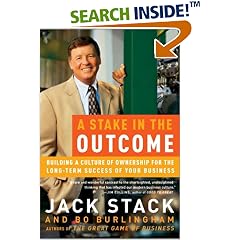
Last month, I wrote briefly about the full day seminar I attended that was hosted by Dr. Don Kuratko. Among other things, Dr. K gave me a whole slew of new books to read (leave it to the college professor to send me home with reading assignments). The first "must read" on his list was "A Stake in the Outcome" by Jack Stack. Being from Kansas City, I immediately assumed that I would be reading about the establishment of a BBQ empire - but apparently, this Jack Stack has not relationship to my favorite smokehouse.
The Jack Stack that wrote this book was a general manager of a engine rebuilding plant in Springfield, Missouri during a major corporate shake-up. Going out on a limb, and with no real idea of what he was doing, he found a bank that would loan him the money for a management buy-out of the plant, establishing the highly successful company SRC Holdings. Having been involved in a couple of small company start-up ventures myself, I can relate to the "figure it out as you go" attitude that Jack and gang adopted in those early days. Unlike my own experiences, though, Jack started out with an existing company with a long history and an established customer base, although over 50% of their revenue came from a single client (something that nearly killed them at one point).
The cornerstone of Jack's success was the creative way in which he got every employee of the company tuned in to what it takes to make the company successful. Contrary to the typical big business approach, where separate groups within the company only focus on their own goals, objectives and measures; Jack determined that, in a small company, everyone had an obligation to understand the ENTIRE profit & loss statement, balance sheet and cash flow. To do this, he invented the "Great Game of Business", a tool that has been adopted by thousands of companies worldwide. The stories in this book are incredible. There is so much living proof out there of the power of enlightenment and engagement, yet so many companies absolutely refuse to disclose their books to more than a handful of internal employees.
This book was a really motivating read! While I don't see myself leading a management buy-out anytime soon, it sure would be fun to find a way to play the great game of business.

Friday, June 20, 2008

The Strategic Tactician


It seems like we end up having this conversation pretty frequently - like every time we debate the potential fit of a new candidate, or when we are assigning positions on the crew of a sailboat racing team. Who is the strategist and who is the tactician?...my question becomes - "Can you truly succeed in one of these roles without being equally successful in another?"
While we all come across individuals who have either by nature, or by design limited themselves to operating in either a "strategic" or "tactical "realm, I have observed that truly successful leaders have usually demonstrated expertise in both areas - I'm really not sure how you can do it any other way.
Going back to my military days - every operating plan was devised based on an overall strategic mission. The top planners, intimately familiar with this mission, would select and assemble the appropriate bundle of tactical moves that, pieced together, would accomplish the strategy. As an officer of the line, it was our job to execute those tactical components to perfection. But as the saying goes - No plan can withstand the test of actual battle. As the execution unfolded, the front line leaders were invariably faced with unexpected circumstances not anticipated by the plan developers. In order to make the right tactical decisions to adjust on the spot, we needed to be intimately familiar with the overall strategy, therefore enabling us to make decisions that not only accomplished our tactical objectives, but also progressed us towards the strategic objectives. Leaders can never de-couple the two.
Conversely, the only way to become a true strategic leader is to have battle-tested knowledge and experience of the tactical environment. Strategic planning has little chance of success if the leaders do not fully understand the capabilities, limitations and dynamics of the "tactical" part of the organization.
Admittedly, there are plenty of people out there who gravitate towards one or the other. I prefer a good mix of both - what's your preference?

Thursday, April 17, 2008

Innovation Dilemma


I've been reading a lot lately, and at a pretty good clip. Thanks to recommendations from friends and associates, I have a growing list of interesting and relevant books to consume. The pace has been pretty healthy as well, about 10 days (or two round-trip plane rides) for each book - I was in a pretty decent groove...until my latest literary conquest. When the book arrived, I sensed immediately that it would be different - it wasn't like the other books I've been reading lately. Now, I've heard that you shouldn't judge a book by its cover - but this book had a vaguely familiar look and feel. It was a hard back, with a glossy cover - reminiscent of those overpriced books you used to carry around campus. Yes - I was about to sit down and read...a college textbook! When is the last time YOU read a college text book? I'm not even sure if I read many in college....


Why am I reading a college textbook? (and will there be an exam at the end of the quarter?) The book is titled: Corporate Entrepreneurship & Innovation. One of the authors, Donald Kuratko, will be teaching a seminar next month in Charlotte that I am attending. Slow pace aside, this book is very insightful and highly relevant. I'm sure there will be multiple blog entries inspired from its pages. Page 58 in Chapter 3 lists Sixteen Dilemmas of Innovation. A few of them really hit home (and echo conversations I have had in recent years).

Innovation Dilemma # 6 - "An innovation succeeds because it addresses customer needs. Yet when you ask customers about their needs, many do not know or can not describe them to you except in general terms."

Innovation Dilemma #13 - "Technology-driven innovation often leads to dramatic new products that prove to be 'better mousetraps' nobody wants." (or can't afford) "Customer-driven innovation often leads to minor modifications to existing products or 'me-too' products meeting a competitive brick wall."

Innovation Dilemma #16 - "Being first to market is not consistently associated with success, while being second or third is not consistently associated with failure."

There are 13 others listed in the table - these 3 just struck a bit of a chord with me. Many companies want the glory and respect associated with being an "Innovator", but most don't want the exposure to potential failed initiatives. I think the fear of failure kills innovation faster than most anything else. One company, fully understanding this concept, created a "Free to Fail" program to encourage moderate risk-taking in the name of innovation. Other examples are listed in page 178 of the text book including:

- Small cash awards given to employees who try something new and fail - and the best failure of the quarter receives a larger award.

I've often encouraged people to celebrate failure - as a way of ensuring that fear of failure does not inhibit creative thinking and action. Companies that continue to only celebrate successes while "blaming away" failures will never reach that pinnacle of innovation and corporate entrepreneurship.

When was your last failure, and how did you celebrate it?

Thursday, April 3, 2008

The not-so-free press

I usually close out my work day with a quick peak at some of my favorite online news feeds and blogs. Today, I came across something a bit odd. One of my favorite bloggers included a link to "Ink" - Kansas City's new online news site. His uncharacteristically terse comment read "go see it. It's cool" Now, when it comes to web sites, very few live to earn the distinction of a "cool" rating on his web scale - so I had to check it out.

What I found was a "beta" site that was just plain NOISY. I don't think I ever really figured out what it was all about or where the real meaningful content was hidden...there was NO WAY this thing could have truly earned a "Cool" rating. I had to go back to the blog to check the date on the entry - maybe this was posted on Tuesday - as a clever April Fools prank...nope, it was new.

I happened to run into the author a few minutes later and got a rather disturbing story... Like me, he had found the site in need of considerable upgrade. True to form, he posted his unbiased and unabridged opinion on his blog - complete with a detailed list of issues that require improvement. (Fittingly - there was no "cool" rating awarded in this original posting)

What he probably failed to consider was that his wife's employer owns the site - so, naturally, she got a call into the boss's office, which led to a call to him with unambiguous instructions as to what she desired....and the honest, unabashed commentary was deleted. I wonder if this is just a small indicator of the inherent rivalry between the traditional press and the internet, which allows rapid dissemination of opinions and criticism without the benefit of political cleansing and quality checks at the hands of the editorial staff....hmmm, makes you wonder, doesn't it??

So, for those of you who might have missed the Ink.com buzz, here is a critical review for mass consumption:


I was just reading Mathew Ingram's remarkable post about the increasing trend of how news is consumed using social networks. He cites a remarkable quote from one 20-something, "If the news is important, it will find me."

The idea is that there just so much news out there that it's virtually impossible to consume it all. Instead, there is a faith that someone you know or trust will pass it on to you via email, RSS, Twitter, blog or other way. It's the new word-of-mouth for our century and it is replacing crushed trees smeared with ink as the medium of choice.

Coincidentally, today marks the launch of The Kansas City Star's new "lifestyle" newspaper named, anachronistically and without irony,
Ink meant for the group Mathew Ingram talks about. There is a print tabloid version, but their website has user blogs and the ability to "friend" others into a trusted group. At first glance it looks like The Kansas City Star's team has put together something to face the future.

But it's awful.

It lacks RSS feeds. The advertising overwhelms the experience. The navigation is bereft of intuitive labeling and placement. The design has the sensibilities of a nausea-inducing MySpace profile. The blogs require "friending" to read, effectively shutting you out without a long wait. In short, it's unreadable.

The content seems like it might be worthwhile, but the design and usability obstacles are so big that I wonder if it matters. My first reaction might be a bit harsh for something that just launched and it does say on their site that it's in beta, but a launch is a launch.

Perhaps these are things they'll revisit and improve upon over time. I guess if it does, the news will find me.

UPDATE: Try Googling "Ink KC" or variations of it. They have *no* search engine visibility. I'd make that my first priority because I really want to see them succeed.

Tuesday, February 5, 2008

The Crystal Ball


"Crystal Ball" is actually a software program that is quite useful at analyzing future events. Keep in mind that "useful" does not necessarily mean "accurate". It's actually a statistical and analytics package, using mathematical methods to predict the probability of certain outcomes based on prior system behavior. Getting back to yesterday's conversation - I can't say that I would use a computer program to assess the potential success or failure of a potential candidate, but the underlying methodology is the same. The big question is this: are you an interpolator or an extrapolator?


An Interpolator only predicts future data that is within the bounds of historical observances. For example, if an interpolator were predicting the exact hour of sunrise, he would need observations from the begining of a month and the end of a month to predict the time of sunrise on, say, the 15th of the month. An extrapolator, however, recognizes trends and patterns and makes a few assumptions. So he may observe the time of sunrise on the first few days of the month and, based on this, predict the time of sunrise later in the month. From an uncertainty or "risk" standpoint, the interpolator is more certain of the correct answer.


So, what does this have to do with predicting success of a new leader? The primary data available to assess the future success of a leader is past experiences. The assumption is that the individual will perform under a similar pattern (interpolators can't be bothered assuming improvements or learning on the part of the leader). So, if I can find someone who has performed a similar or identical job function in a similar or identical company with a level of success, it doesn't take much analytical power to predict a high potential for success in the new job. Interpolators look for the "been there, done that" candidate.


Extrapolating, however, takes a bit of work and gets decision-makers a lot more nervous. Just like in statistical modeling and prediction, extrapolating human performance requires a thorough understanding of the inner workings of human motivation and team dynamics. It takes as much intuition as analytics to come up with a reasonable estimate. Going back to yesterday's conversation, this is where the discussion of learning from mistakes versus never making mistakes comes into play. What does the extrapolator use as a modeling assumption? Do you assume that the person has learned a lot from their mistakes and will be effective at avoiding similar mistakes in the future? Do you assume that someone who has made mistakes in the past is more likely to make mistakes in the future? Do you prefer someone who has a seemingly unblemished record, assuming that they are smart enough to never make a major mistake? It's always a lively discussion.
Fill a room with a combination of interpolators and extrapolators, each with a different set of experiences. Have them all interview a candidate for a newly created position in a unique matrix organization (one that has few, if any, direct parallels in peer companies), and sit in the room and listen to the debate about who is the best candidate. You don't need a crystal ball to determine the outcome of that exercise....


Monday, February 4, 2008

Celebrating Failure

Our lunchtime question of the day (Bill Wurtz contributing): which candidate would you hire; (1) the candidate with no business failures listed on her record, only a string of successes, (2) the candidate that has a mixture of failures and successes on his record, but has a good explanation for the external factors that led to the failures, none of which were his own mistakes, or (3) the candidate with a mixture of success and failures, admittedly having made mistakes along the way that contributed to the lack of success? Be careful asking this question in public - it can lead to a long and unfriendly lunch time conversation, depending on the personal experiences of the group. Personally, I think there is a right and a wrong answer on this one, and the answer "it depends" can't be used in this game. Of course, how you rationalize the right and wrong answer depends upon your understanding of human learning, self awareness, integrity and conflict management.

In the Navy, there always seemed to be those "golden boys" - the ones who somehow managed to be assigned to the perennial top-performing organizations. They were leaders in high performing and successful organizations that were high performing and successful before they arrived for their 2-year tour and long after they departed. Then there were others that somehow managed to draw all of the turn-around situations, continuously assigned to organizations with poor performance, with the assignment of turning them around. In which of these two groups would you expect to "learn" more about leadership? As a 12-year member of the latter group, I certainly have a strong opinion on the subject...

Does anyone actually "celebrate" their mistakes? What about "celebrating" their failures? To be sure, let's isolate our discussion of mistakes and failures to those that came out of honest efforts to succeed. Obvious illegal or unethical activities are excluded from this category - that's a different level of learning. Let's assume, for a minute, that after the fact, we are able to analyze and understand the faults in our logic and decision-making that led to the failure. Let's also assume that we have the insight to use this analysis to drive our decision-making in future situations with similar circumstances. We've just accomplished something called "learning" - couldn't this be cause for celebration?

I know, I know...you can learn just as much by making the correct decision the first time, right? Well, think about it...how much time to you spend dissecting the every move when the outcome was a success? I'll bet you do a lot more thorough post-mortem analysis if things did not turn out the way you expected. No one likes to be wrong - and you're much more motivated to prevent this situation in the future.

So, back to our candidates and my pointedly unfair question. Candidate #1 (aka "golden boy") has fewer learning opportunities - or alternatively, is not being forthright about his mis-steps. Not admitting to mistakes rarely works in a corporate setting. Candidate #2 (aka "the blamestormer") has everyone but himself to blame for his mistakes. While uncontrollable circumstances have a lot to do with success, the pattern of placing fault elsewhere can be very disruptive. So, in the absence of any other information - my preference is for candidate #3.


Of course, I would never hire anyone based on what they have already done. A new leader is brought in based on what they are going to do after they arrive. Which leads to the next emotionally debated topice: how do you predict success when choosing the "new guy"???