Showing posts with label education. Show all posts

Monday, July 7, 2008

Another fun book - for serial Entreprenuers


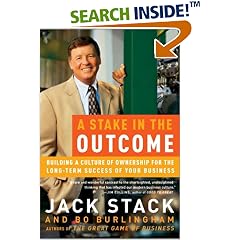
Last month, I wrote briefly about the full day seminar I attended that was hosted by Dr. Don Kuratko. Among other things, Dr. K gave me a whole slew of new books to read (leave it to the college professor to send me home with reading assignments). The first "must read" on his list was "A Stake in the Outcome" by Jack Stack. Being from Kansas City, I immediately assumed that I would be reading about the establishment of a BBQ empire - but apparently, this Jack Stack has not relationship to my favorite smokehouse.
The Jack Stack that wrote this book was a general manager of a engine rebuilding plant in Springfield, Missouri during a major corporate shake-up. Going out on a limb, and with no real idea of what he was doing, he found a bank that would loan him the money for a management buy-out of the plant, establishing the highly successful company SRC Holdings. Having been involved in a couple of small company start-up ventures myself, I can relate to the "figure it out as you go" attitude that Jack and gang adopted in those early days. Unlike my own experiences, though, Jack started out with an existing company with a long history and an established customer base, although over 50% of their revenue came from a single client (something that nearly killed them at one point).
The cornerstone of Jack's success was the creative way in which he got every employee of the company tuned in to what it takes to make the company successful. Contrary to the typical big business approach, where separate groups within the company only focus on their own goals, objectives and measures; Jack determined that, in a small company, everyone had an obligation to understand the ENTIRE profit & loss statement, balance sheet and cash flow. To do this, he invented the "Great Game of Business", a tool that has been adopted by thousands of companies worldwide. The stories in this book are incredible. There is so much living proof out there of the power of enlightenment and engagement, yet so many companies absolutely refuse to disclose their books to more than a handful of internal employees.
This book was a really motivating read! While I don't see myself leading a management buy-out anytime soon, it sure would be fun to find a way to play the great game of business.

Monday, April 7, 2008

The Kansas City Science Fair


There are certain annual events that I have to include on my "can't wait until next year" list. One is the annual NSF SBIR conference (that I am unfortunately missing next week) and the other, without a doubt, is the Kansas City Science Fair, sponsored by Science Pioneers. I never actually entered a science fair as a kid - can't really say why, it's just not something I ever did.


Last year, an associate at the office asked me if I could volunteer to be a judge at the KC Science Fair. Everyone knows how passionate I get when it comes to working with and around kids, so I obviously did not hesitate. As a first year judge, I started at the elementary school level, only judging papers and displays. It was actually pretty straightforward - the required attribute sheet was very complete and most all projects were well developed. The one thing I did NOT get to do was talk to the students - that's only at the junior high and high school level. For me, the best way to judge how much a student accomplished during the execution of a project is to speak to them face-to-face, without that element, I just felt like I was missing out.


This year, I signed up for the junior engineering division - where I had the opportunity to judge and speak to several 7th and 8th grade students. It was fabulous. These young boys and girls were genuinely passionate about their individual projects, and many of them really had a good time doing them. Overall, I have only one complaint (that applies to all projects I reviewed last year and this year as well) - there is not enough emphasis on celebrating failure.


I wonder if it is human nature or just the manner in which science is taught these days. It's as if the definition of a successful experiment is one in which the student can exactly predict the results, then run an experiment that fully supports their hypothesis. As I mentioned to one student "If you proved what you already knew, then what have you really learned here?" I believe that real learning starts when we encounter the unexpected. New discoveries evolve from failed hypotheses. I fear that many of these kids are so focused on creating a nice little report that neatly fits into the standard format that they avoid true experimentation and discovery....


Of course, these were my concerns and conclusions after reading the reports, prior to the students' arrival. During oral interviews, a whole different story emerged - EVERY TIME. Talking freely about their experiments, each of the students I met had a great story to tell about experimental failures, shifts in thought process and critical thinking about follow-on projects and alternate hypothesis. This was utterly delightful! I could have visited with these enthusiastic young men and women all evening.


So, the thing that's really missing is not the method and thought process, but the ability to break from the highly structured format of a science report to adequately write their story of discovery....funny thing is - you don't have to look far to see the exact same issue in the business world. We're so programmed to fill in the template and follow the predefined structure, that we lose the ability to tell our story. My advice: throw out the form, forget the template - start with a blank sheet of paper and tell your story. By the way - this is the EXACT same advice I had for several presenters at last year's NSF SBIR Phase II grantee conference. So, what's your story?