Showing posts with label Success. Show all posts

Monday, July 7, 2008

Another fun book - for serial Entreprenuers


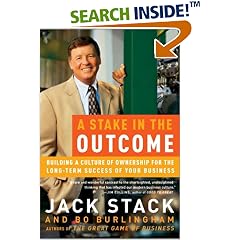
Last month, I wrote briefly about the full day seminar I attended that was hosted by Dr. Don Kuratko. Among other things, Dr. K gave me a whole slew of new books to read (leave it to the college professor to send me home with reading assignments). The first "must read" on his list was "A Stake in the Outcome" by Jack Stack. Being from Kansas City, I immediately assumed that I would be reading about the establishment of a BBQ empire - but apparently, this Jack Stack has not relationship to my favorite smokehouse.
The Jack Stack that wrote this book was a general manager of a engine rebuilding plant in Springfield, Missouri during a major corporate shake-up. Going out on a limb, and with no real idea of what he was doing, he found a bank that would loan him the money for a management buy-out of the plant, establishing the highly successful company SRC Holdings. Having been involved in a couple of small company start-up ventures myself, I can relate to the "figure it out as you go" attitude that Jack and gang adopted in those early days. Unlike my own experiences, though, Jack started out with an existing company with a long history and an established customer base, although over 50% of their revenue came from a single client (something that nearly killed them at one point).
The cornerstone of Jack's success was the creative way in which he got every employee of the company tuned in to what it takes to make the company successful. Contrary to the typical big business approach, where separate groups within the company only focus on their own goals, objectives and measures; Jack determined that, in a small company, everyone had an obligation to understand the ENTIRE profit & loss statement, balance sheet and cash flow. To do this, he invented the "Great Game of Business", a tool that has been adopted by thousands of companies worldwide. The stories in this book are incredible. There is so much living proof out there of the power of enlightenment and engagement, yet so many companies absolutely refuse to disclose their books to more than a handful of internal employees.
This book was a really motivating read! While I don't see myself leading a management buy-out anytime soon, it sure would be fun to find a way to play the great game of business.

Friday, June 20, 2008

The Strategic Tactician


It seems like we end up having this conversation pretty frequently - like every time we debate the potential fit of a new candidate, or when we are assigning positions on the crew of a sailboat racing team. Who is the strategist and who is the tactician?...my question becomes - "Can you truly succeed in one of these roles without being equally successful in another?"
While we all come across individuals who have either by nature, or by design limited themselves to operating in either a "strategic" or "tactical "realm, I have observed that truly successful leaders have usually demonstrated expertise in both areas - I'm really not sure how you can do it any other way.
Going back to my military days - every operating plan was devised based on an overall strategic mission. The top planners, intimately familiar with this mission, would select and assemble the appropriate bundle of tactical moves that, pieced together, would accomplish the strategy. As an officer of the line, it was our job to execute those tactical components to perfection. But as the saying goes - No plan can withstand the test of actual battle. As the execution unfolded, the front line leaders were invariably faced with unexpected circumstances not anticipated by the plan developers. In order to make the right tactical decisions to adjust on the spot, we needed to be intimately familiar with the overall strategy, therefore enabling us to make decisions that not only accomplished our tactical objectives, but also progressed us towards the strategic objectives. Leaders can never de-couple the two.
Conversely, the only way to become a true strategic leader is to have battle-tested knowledge and experience of the tactical environment. Strategic planning has little chance of success if the leaders do not fully understand the capabilities, limitations and dynamics of the "tactical" part of the organization.
Admittedly, there are plenty of people out there who gravitate towards one or the other. I prefer a good mix of both - what's your preference?

Thursday, April 17, 2008

Innovation Dilemma


I've been reading a lot lately, and at a pretty good clip. Thanks to recommendations from friends and associates, I have a growing list of interesting and relevant books to consume. The pace has been pretty healthy as well, about 10 days (or two round-trip plane rides) for each book - I was in a pretty decent groove...until my latest literary conquest. When the book arrived, I sensed immediately that it would be different - it wasn't like the other books I've been reading lately. Now, I've heard that you shouldn't judge a book by its cover - but this book had a vaguely familiar look and feel. It was a hard back, with a glossy cover - reminiscent of those overpriced books you used to carry around campus. Yes - I was about to sit down and read...a college textbook! When is the last time YOU read a college text book? I'm not even sure if I read many in college....


Why am I reading a college textbook? (and will there be an exam at the end of the quarter?) The book is titled: Corporate Entrepreneurship & Innovation. One of the authors, Donald Kuratko, will be teaching a seminar next month in Charlotte that I am attending. Slow pace aside, this book is very insightful and highly relevant. I'm sure there will be multiple blog entries inspired from its pages. Page 58 in Chapter 3 lists Sixteen Dilemmas of Innovation. A few of them really hit home (and echo conversations I have had in recent years).

Innovation Dilemma # 6 - "An innovation succeeds because it addresses customer needs. Yet when you ask customers about their needs, many do not know or can not describe them to you except in general terms."

Innovation Dilemma #13 - "Technology-driven innovation often leads to dramatic new products that prove to be 'better mousetraps' nobody wants." (or can't afford) "Customer-driven innovation often leads to minor modifications to existing products or 'me-too' products meeting a competitive brick wall."

Innovation Dilemma #16 - "Being first to market is not consistently associated with success, while being second or third is not consistently associated with failure."

There are 13 others listed in the table - these 3 just struck a bit of a chord with me. Many companies want the glory and respect associated with being an "Innovator", but most don't want the exposure to potential failed initiatives. I think the fear of failure kills innovation faster than most anything else. One company, fully understanding this concept, created a "Free to Fail" program to encourage moderate risk-taking in the name of innovation. Other examples are listed in page 178 of the text book including:

- Small cash awards given to employees who try something new and fail - and the best failure of the quarter receives a larger award.

I've often encouraged people to celebrate failure - as a way of ensuring that fear of failure does not inhibit creative thinking and action. Companies that continue to only celebrate successes while "blaming away" failures will never reach that pinnacle of innovation and corporate entrepreneurship.

When was your last failure, and how did you celebrate it?

Sunday, February 10, 2008

I - It :: I - You


In the early 90's, Daniel Goleman published the best-selling book "Emotional Intelligence". As an officer in the military, facing frustrations with the limitations of stereotypical military leadership styles and attitudes, reading this book gave me great hope and insight. At least I wasn't the only person that believed that being in touch with human emotions was critical to success - especially in a leadership role. Have you taken an emotional intelligence lately? I did OK on mine - although I obviously have room for improvement in a couple of areas...Goleman's latest book - "Social Intelligence" is equally eye opening. One theme he explores in his latest work is the personal versus impersonal mode of human interaction. He introduces the I-It concept as a common behavior in which we overlook the human aspect of people we meet in certain settings. This is especially prevalent in the medical and service industries. How many times have you treated another person as an "it"? I see it every week when I travel - so many airline employees, from ticket agents to flight attendants, passengers and customers showing utter disregard for the fact that they are interacting with another human being. The alternative approach - the I-You interaction, involves an awareness of the other person, including sensitivity to their emotional state. The I-it is certainly more convenient in many situations, and it requires a whole lot less stress and effort - when I stop at Starbucks, I just want a cup of coffee, I’m usually not prepared to hear the latest emotional ills of my neighborhood barista... But how often do we choose the I-it style when we really don't have to? Try this - next time you're out for a meal at a restaurant and the waiter/waitress refills your water glass, take the time to look them in the eye, smile and extend a warm "thank you". Hold the gaze long enough to measure their reaction. At the same time, assess your own internal reaction to the 2-second gesture - you may be surprised. The brain responds to this sort of social interaction in milliseconds - you'll be amazed at what that 2-second pause will do for you. Invest about 3 minutes in a day, in two-second increments, to these random acts of I-you and let me know how it turns out...

Monday, February 4, 2008

Celebrating Failure

Our lunchtime question of the day (Bill Wurtz contributing): which candidate would you hire; (1) the candidate with no business failures listed on her record, only a string of successes, (2) the candidate that has a mixture of failures and successes on his record, but has a good explanation for the external factors that led to the failures, none of which were his own mistakes, or (3) the candidate with a mixture of success and failures, admittedly having made mistakes along the way that contributed to the lack of success? Be careful asking this question in public - it can lead to a long and unfriendly lunch time conversation, depending on the personal experiences of the group. Personally, I think there is a right and a wrong answer on this one, and the answer "it depends" can't be used in this game. Of course, how you rationalize the right and wrong answer depends upon your understanding of human learning, self awareness, integrity and conflict management.

In the Navy, there always seemed to be those "golden boys" - the ones who somehow managed to be assigned to the perennial top-performing organizations. They were leaders in high performing and successful organizations that were high performing and successful before they arrived for their 2-year tour and long after they departed. Then there were others that somehow managed to draw all of the turn-around situations, continuously assigned to organizations with poor performance, with the assignment of turning them around. In which of these two groups would you expect to "learn" more about leadership? As a 12-year member of the latter group, I certainly have a strong opinion on the subject...

Does anyone actually "celebrate" their mistakes? What about "celebrating" their failures? To be sure, let's isolate our discussion of mistakes and failures to those that came out of honest efforts to succeed. Obvious illegal or unethical activities are excluded from this category - that's a different level of learning. Let's assume, for a minute, that after the fact, we are able to analyze and understand the faults in our logic and decision-making that led to the failure. Let's also assume that we have the insight to use this analysis to drive our decision-making in future situations with similar circumstances. We've just accomplished something called "learning" - couldn't this be cause for celebration?

I know, I know...you can learn just as much by making the correct decision the first time, right? Well, think about it...how much time to you spend dissecting the every move when the outcome was a success? I'll bet you do a lot more thorough post-mortem analysis if things did not turn out the way you expected. No one likes to be wrong - and you're much more motivated to prevent this situation in the future.

So, back to our candidates and my pointedly unfair question. Candidate #1 (aka "golden boy") has fewer learning opportunities - or alternatively, is not being forthright about his mis-steps. Not admitting to mistakes rarely works in a corporate setting. Candidate #2 (aka "the blamestormer") has everyone but himself to blame for his mistakes. While uncontrollable circumstances have a lot to do with success, the pattern of placing fault elsewhere can be very disruptive. So, in the absence of any other information - my preference is for candidate #3.


Of course, I would never hire anyone based on what they have already done. A new leader is brought in based on what they are going to do after they arrive. Which leads to the next emotionally debated topice: how do you predict success when choosing the "new guy"???